
Much of Michiel’s testimony was centered on his being stalked, threatened, and extorted by Mark Stover over the course of nearly 6 months. Although some may question Michiel’s testimony based on his behavior during this time, his actions were actually consistent with those of numerous other stalking victims, as Stover’s were with typical stalkers.
Mark Stover’s History
Despite being a talented and charismatic dog trainer, Mark Stover had a dark side that few people saw. He stalked his ex-wife, Linda Opdycke, for years following their separation. Among his activities during this time, Stover repeatedly harassed her through obsessive, threatening, and obscene phone calls, as well as voicemails and letters in which he often referred to a set of “wedding photos” that he believed she possessed. He confronted her in person on multiple occasions, despite the 3-7 hour drive (depending on seasonal routes) from his home. He tapped her phone line and accessed private communications on her computer. He broke into her house on multiple occasions, several times while Linda was away, once waiting for her as she exited the shower, and another while she was asleep. She awoke to his gun on her pillow and him talking about killing himself, he was frantic, emotionally unstable, and she feared for her life. Stover was finally caught and convicted of stalking, after a neighbor stopped him in the act of stealing Linda’s garbage for personal information.
As is often the case with stalking, most of Stover’s invasive and harmful actions were not witnessed by anyone except his target.
The Next Victim
Once Michiel and Linda had formed a friendship, and then a relationship, Stover reappeared, this time to Michiel. The following excerpt is from Michiel’s testimony:
Michiel Oakes: “I met Mr. Stover the last week of May at Costco…it was either a Tuesday or a Wednesday as I recall. He was waiting for me out by my car.
He told me that I was going to do something for him. He began to describe what my daughters were wearing that morning, that day. He told me that I was going to get some wedding photos for him and meet him at the Northgate Mall and everything would be ok with me and my kids.
He said ‘I can reach out and touch your kids any day.’”
John Henry Brown: “Did you think about calling the police?”
Michiel Oakes: “I actually picked up my phone to call the police.”
John Henry Brown: “Why didn’t you?”
Michiel Oakes: “I worked with cops for years, I knew what that conversation was going to be like; I didn’t have any evidence.”
From a later portion of his testimony:
John Henry Brown: “So how did the conversation at Northgate Mall go?”
Michiel Oakes: “He said that he was frustrated but he seemed calm and he said that I wasn’t taking him seriously and that I needed to get the wedding photos and that I hadn’t tried. Then he said that he would be in touch and that I was going to get the photos for him and he made a [comment] about the kids.”
John Henry Brown: “Did he say anything about, ‘You know what will happen if you don’t.’?”
Michiel Oakes: “Yes. That was the [one] about the kids.”
Michiel’s children later testified that around this time he had suddenly become cautious and very alert. He instructed them on the use of firearms and self-defense. He asked them if they had seen strange vehicles around school, or “middle-aged men” watching them. After Michiel’s oldest daughter moved to California, Michiel began home-schooling his two youngest, in order to keep them close at all times.
Mark Stover continued to target Michiel, sometimes arranging meetings in advance, other times appearing to Michiel without warning. He continued to demand that Michiel bring him the wedding photos, and continued to threaten Michiel and his children. Throughout this ordeal, Michiel tried repeatedly to defuse the situation. With each encounter, he attempted to reason with and appease Mark, constantly seeking a peaceful resolution, and hoping that Mark would simply leave him and his family alone. After 6 months of bullying, harassing, and threatening Michiel, Stover arranged a final meeting, this time at his own house.
Questions Raised
As Stover’s malicious and threatening activities went unwitnessed and unchecked (much like his earlier stalking of Linda), most everything in court was dependent on Michiel’s testimony. Michiel’s account of these events stood uncontested, but in some ways raised as many questions as it answered.
Why did Mark Stover go after Michiel?
Stalking is an inherently obsessive behavior and, for intimate partner stalkers, this obsession can often become possessive; a need to control or dominate. A study conducted by the University of Missouri showed that stalking victims’ next intimate partners were threatened in 18% of cases. In 6% of cases, the intimate partners were harmed. In fact, Michiel was not the first person to fear for their children’s safety on Mark’s account. Linda entered into a brief relationship 2 years after separating from Mark Stover; the letter below depicts the conclusion of this relationship. (“Theo” is short for “Theodore”, Stover’s legal first name).
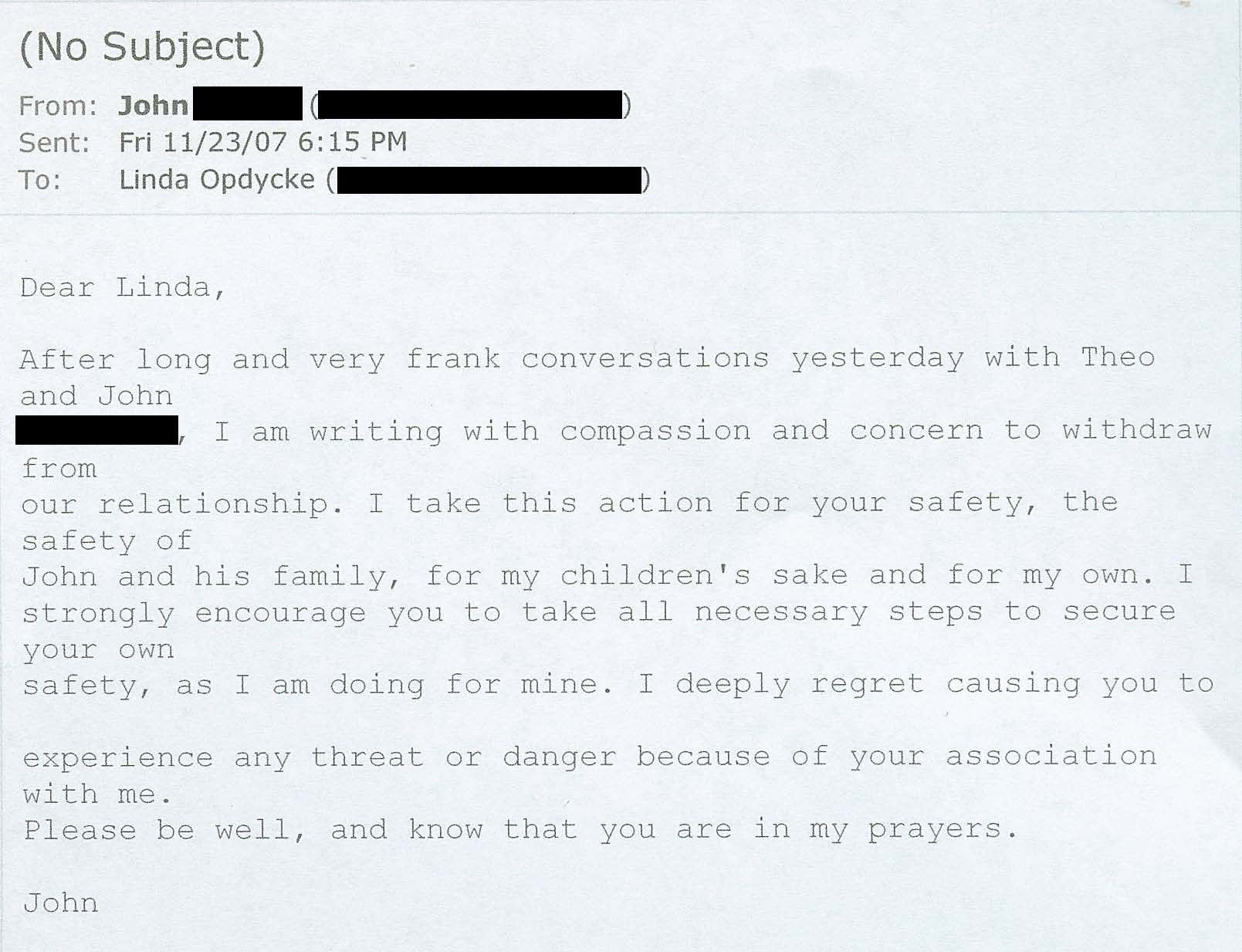
By targeting Michiel, Stover was continuing a pattern of dangerous and aggressive behavior already proven in court.
Why didn’t Michiel contact the police?
You may recognize the following quote from above:
Michiel Oakes: “I actually picked up my phone to call the police.”
John Henry Brown: “Why didn’t you?”
Michie Oakesl: “I worked with cops for years, I knew what that conversation was going to be like; I didn’t have any evidence.”
This excerpt from Michiel’s testimony provides a partial answer, but Michiel’s beliefs were well-founded. According to studies, approximately half of stalking victims do not report their situations to the police. Of those that do, more than three-quarters report that police involvement had either no effect, or it made matters worse.
Why didn’t anyone notice?
It seems unlikely at first that nobody would notice a change in Michiel’s (or Mark’s) behavior surrounding these events. With such threatening and dangerous actions, shouldn’t there have been more witnesses? Unfortunately, no. Stalking, as well as the aggression, extortion, and violence that accompany it, is one of the most difficult crimes to prosecute, largely because it is so rarely witnessed. In fact, fewer than 10% of men in Michiel’s position, male stalking victims, reported a successful conviction of their stalker.
This principle is demonstrated by the fact that Mark stalked Linda for more than a year, invading her life completely unchecked, until her neighbor witnessed him stealing her trash. If his actions went unnoticed and unheeded for so long with his first victim, it is reasonable to assume the same outcome in Michiel’s case.
Click here to return to “Circumstance”, or continue reading information on stalking below.
Stalking Facts
The behavior of each person in these situations may at first seem unusual or even unbelievable. However, these events conform very clearly with the known behavior of both stalkers and their victims.
Stalkers are dangerous
- 54% of femicide victims (female homicide victims) reported being stalked to police before they were killed by their stalkers. [1]
- 76% of intimate partner femicide victims had been stalked by their intimate partner. [1]
- 90% of women murdered are killed by men who are most often a family member, spouse or ex-partner. [2]
- In the U.S. women are more likely to be killed by their male intimate partners than all other homicide categories combined. [2]
- The most likely group of stalkers to be violent are those individuals who have had a prior sexually intimate relationship with the victim. [3]
- Stalker Contact Violence occurs in 30% of cases. [4]
- Approximately 50% of stalking victims do not report the crime to the police. [4]
- 77% of respondents indicated that “police involvement either had no effect or made the stalker’s behavior worse.” [5]
- 69% of female victims and 81% of male victims had their protection orders violated. [1]
- In 21 percent of cases, violence and stalking escalate after the protective order is issued. [8]
- Only 9% of male victims report their stalker being convicted. [4]
- Threats are made to a stalking victim’s new partner in 18% of cases. [6]
- Harm is caused to the new partner in 6% of cases. [6]
Sources
For information on National Stalking Awareness Month, see the Presidential Proclamation here.
- http://www.ncvc.org/src/AGP.Net/Components/DocumentViewer/Download.aspxnz?DocumentID=40616
- http://www.prisonactivist.org/archive/women/self-defense-not-a-crime.html
- http://www.uky.edu/CRVAW/files/Stalking%20Victimization1.pdf
- http://www.csub.edu/~dhall/crju430/Outside_Looking_In.ppt
- Brewster, 1998 http://books.google.com/books?id=UND7Ps1ZZkEC&pg=PA417&lpg=PA417&dq=stalking+rate+new+partner&source=bl&ots=VO965qZyBV&sig=YXx_QpmNfNwH8JdzsjlyjcYHeAI&hl=en&ei=8EI2TbDhO5H6sAPaooSHAg&sa=X&oi=book_result&ct=result&resnum=4&ved=0CC8Q6AEwAw#v=onepage&q=stalking%20rate%20new%20partner&f=false
- http://www.ncbi.nlm.nih.gov/pmc/articles/PMC2977930/
- http://www.ncjrs.gov/pdffiles/fs000186.pdf
- http://www.ncvc.org/ncvc/main.aspx?dbName=DocumentViewer&DocumentID=39538

 Free Oakes